The Running Shoe Industry Has a Problem Nobody Wants to Talk About
Running shoes are getting smarter, more expensive, and somehow harder to shop for. At what point did buying a pair of shoes become more complicated than actually running?
By Brenna Scarpelli, Co-Founder of Mile Supply ·
Remember when buying running shoes was simple?
You walked into a store, tried on a few pairs, found something comfortable, and went home.
Maybe you even picked the blue ones because they looked cool. Revolutionary stuff.
Today? You practically need a degree in biomechanics.
Do you need a carbon plate? A PEBA midsole? Maximum cushioning? Stability? A rocker geometry? What about your pronation?
And what on earth is a super trainer?
You came in looking for something to jog around the neighborhood in. Now you're contemplating a $250 pair of shoes and wondering if your feet have been operating at a competitive disadvantage your entire life.
Here's the thing: running shoe technology has genuinely improved. Some of the innovations coming out of the industry are fascinating, and the science behind them is real.
But somewhere along the way, the running shoe industry got really good at telling us what its shoes can do, and less good at helping us figure out what we actually need.
And that's worth talking about.
When Did Running Shoes Become a Luxury Purchase?
Let's talk money.
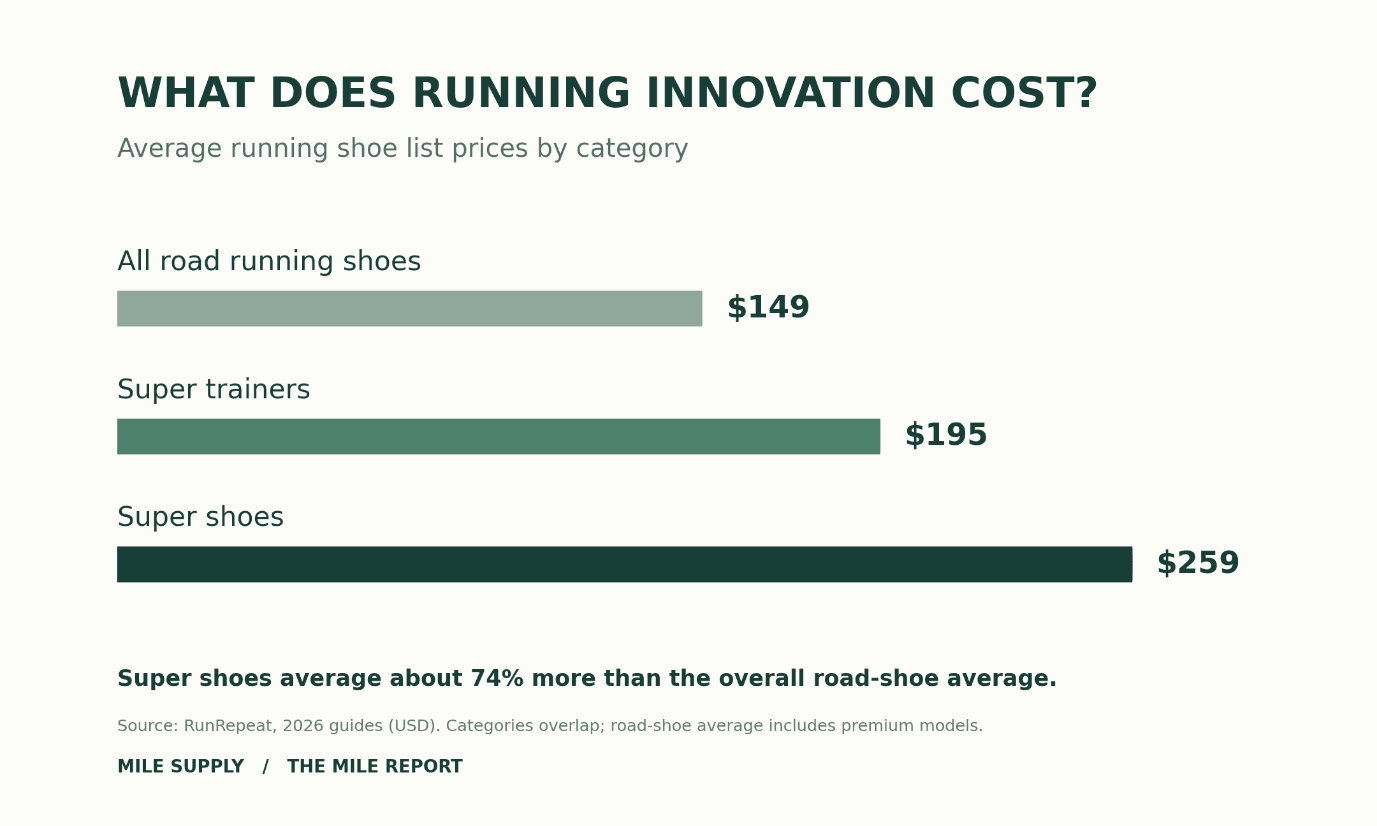
According to RunRepeat's running shoe data, the average road running shoe costs approximately $149, while super trainers average around $195 and super shoes around $259.
For context, $259 can buy you a decent amount of groceries, several race entries, or approximately four cups of coffee at an airport.
Okay, maybe six.
But seriously, that's a significant investment for something you're going to repeatedly smack against the pavement.
To be fair, not all running shoes cost $250. Plenty of excellent options are available for considerably less, especially when previous-generation models go on sale.
And expensive shoes aren't automatically overpriced. Advanced materials, specialized manufacturing, research, and development all carry costs.
But here's the question we think gets overlooked:
Are everyday runners being given enough information to understand what they're actually paying for?
Because there's a meaningful difference between paying more for something that improves your running experience and paying more because you've been convinced you're missing out.
Those aren't necessarily the same purchase.
The Technology Is Real. The Hype Is Where Things Get Complicated.
Before anyone accuses us of hating innovation, we should make something clear.
We're pretty big fans of innovation.
Modern running shoe technology is impressive. Particularly the combination of highly responsive foams, stiff plates, and carefully designed shoe geometry.
In fact, a 2026 systematic review and meta-analysis found that carbon-plated footwear was associated with an average reduction in runners' metabolic demand of approximately 2.75% across the outcomes studied.
That's meaningful.
But let's explain what it actually means.
Running economy is essentially how much energy your body uses to maintain a particular running speed.
Think of it like fuel efficiency in a car.
If your running economy improves, you may be able to maintain the same pace using less energy.
Pretty cool, right?
Here's where we need to be careful, though.
A 2.75% reduction in metabolic demand does not mean you're automatically going to run a 2.75% faster marathon.
And it definitely doesn't mean you can skip training, buy fancy shoes, and suddenly qualify for Boston.
We checked. Unfortunately, the training part still matters.
The research also shows that different runners can respond differently to the same technology. Shoe design, running speed, individual biomechanics, and the comparisons used in studies all matter.
So yes, expensive running shoes can provide genuine benefits.
But whether those benefits are worth another $100 to you is a completely different question.
If you're chasing a personal record, a premium racing shoe might be a worthwhile investment.
If you're doing three easy runs a week because running helps you decompress after work, you may be perfectly happy in a comfortable daily trainer.
Neither runner is doing it wrong.
The best shoe isn't necessarily the most technologically advanced one. It's the one that makes sense for the runner wearing it.
The Injury Prevention Conversation Gets Even Messier
You've probably heard some version of this advice:
"You overpronate, so you need stability shoes."
Or:
"You need more cushioning to protect your knees."
Or maybe:
"That shoe doesn't have enough support for you."
Now, footwear characteristics can absolutely influence how we move and how a shoe feels.
But does choosing a particular category of running shoe reliably prevent injuries?
The scientific answer is considerably less definitive than many runners might expect.
A 2022 Cochrane systematic review examined research on different running shoe types and lower-limb injuries.
The researchers found substantial uncertainty about whether particular shoe categories prevent injuries better than others. Much of the evidence was rated as low or very low certainty.
That's not the same as saying running shoes don't matter.
It means we don't have strong enough evidence to confidently promise that one particular shoe category will protect every runner from injury.
And that's an important distinction.
Your individual comfort, running history, training load, strength, and biomechanics may all play a role in your running experience.
A shoe that feels fantastic to your running buddy might feel like two overpriced bricks strapped to your feet.
Personally, we think that's a pretty good reason to stop treating every shoe recommendation like a universal prescription.
A running shoe can be a useful tool.
It just isn't a magical force field for your knees.
And Who Decided Your Shoes Expire at 300 Miles?
Let's discuss one of our favorite running debates.
The mysterious running shoe expiration date.
You've probably heard that you should replace your running shoes somewhere around 300 to 500 miles.
It's such a familiar recommendation that it can start to feel like a law of nature.
Hit 300 miles? Congratulations. Your shoes are now pumpkins.
Except that's not quite how shoe durability works.
Different shoes use different midsole materials, outsole compounds, construction methods, and foam geometries. Different runners also place different demands on their shoes.
Someone running primarily on smooth pavement may experience wear differently from someone who regularly runs on rough surfaces.
And two runners wearing exactly the same model might have completely different experiences over time.
A 2025 study examining running shoe end-of-life found that visible shoe wear was the most commonly reported reason for replacement among surveyed road and trail runners.
The researchers also questioned the usefulness of rigid mileage limits, particularly as footwear materials evolve.
That doesn't mean you should run in the same shoes forever.
If your outsole is worn through, your shoes feel noticeably different, the upper is failing, or you're experiencing new discomfort, it's worth reassessing them.
And mileage can still be a useful reminder to inspect your shoes more closely.
But it isn't a countdown timer that automatically renders your footwear useless.
A number on your running watch shouldn't be the only thing deciding when you spend another $150.
Your shoes have a story to tell.
Look at them. Feel how they perform. Pay attention to changes.
Just maybe don't wait until your toes are waving at passing cars through a hole in the upper.
Let's Talk About Running Shoe Reviews
Now for the slightly uncomfortable part.
You open Instagram, TikTok, or YouTube.
A creator is holding the newest running shoe.
It's apparently the most comfortable, responsive, revolutionary shoe they've ever worn.
Amazing.
You scroll down.
Another creator says the same thing about another shoe.
Then another.
At this point, we're starting to wonder whether a running shoe has ever been released that wasn't a game changer.
Here's where things get complicated.
Content creators can receive free products, sponsorship payments, affiliate commissions, or other incentives connected to the shoes they discuss.
None of those arrangements automatically makes a review dishonest.
In fact, some independent reviewers do outstanding work testing shoes, comparing measurements, and documenting their experiences.
But a glowing first impression isn't the same as a long-term test.
And "I love this shoe" isn't particularly helpful unless you understand who's saying it, how they tested it, and whether their running preferences resemble yours.
There's also an important transparency issue.
The Federal Trade Commission's endorsement guidance explains that material relationships between reviewers and brands need to be clearly disclosed when they could affect how consumers evaluate an endorsement.
That matters because consumers deserve to understand the context behind recommendations.
And we want to be clear: Mile Supply isn't exempt from that standard.
We work with affiliate relationships too, and some of our recommendations may eventually earn us a commission.
That makes transparency more important, not less.
A useful recommendation should help you make a better decision even when the person making it doesn't earn anything from your purchase.
That's the standard we want to hold ourselves to.
So What Should You Actually Look for in Running Shoes?
After all that, you might be thinking:
"Great. You've told me everything is complicated. Now what?"
Fair question.
The good news is that buying running shoes doesn't have to be nearly as overwhelming as we've made it.
Start with five questions.
1. What are you actually using them for?
Daily runs? Speed workouts? Trail adventures? Racing?
A shoe designed for elite marathon racing doesn't necessarily make the best choice for relaxed neighborhood runs.
Match the shoe to the job.
2. Do they actually feel good on your feet?
Not your friend's feet.
Not the influencer's feet.
Yours.
Pay attention to fit, heel security, toe room, pressure points, and how comfortable you feel moving around.
Don't assume a shoe will become perfect after 50 miles if it already feels wrong in the store.
3. Is there evidence behind the feature you're paying for?
Carbon plates, highly responsive foams, and specialized geometries aren't meaningless marketing terms.
But before paying extra, ask yourself whether that particular feature addresses something you care about.
A measurable performance benefit may be valuable to one runner and completely unnecessary to another.
4. How much are you willing to spend?
There's absolutely nothing wrong with setting a budget.
You don't need to apologize for not wanting to spend $250 on running shoes.
And don't overlook last year's models. A new version doesn't automatically make its predecessor obsolete.
5. Are you buying the shoe or the excitement around it?
This one's worth thinking about.
It's fun to get excited about new gear.
We're running enthusiasts. We get it.
Sometimes you just want the bright orange shoes because they're bright orange.
Honestly? Fair enough.
But there's a difference between buying something because you genuinely want it and feeling like you have to buy it to be a legitimate runner.
You can love running gear without letting running gear define how good a runner you are.
The Real Problem Isn't Expensive Shoes
Let's give the running shoe industry credit where it's due.
Innovation has helped make some shoes lighter, more responsive, and more capable than previous generations.
That's genuinely exciting.
And plenty of runners enjoy researching shoes, experimenting with different models, and collecting more footwear than their closets were originally designed to accommodate.
No judgment.
Well, maybe a little judgment if you have 17 pairs and insist they're all absolutely essential.
But the real problem isn't that running companies make expensive shoes.
It's that the conversation around running shoes can make buying the latest technology feel like a requirement rather than a choice.
We hear plenty about what's new.
We hear plenty about what's faster.
We hear plenty about what's revolutionary.
We'd like to hear a little more about what's actually necessary.
Because for most of us, running isn't about having the most advanced equipment available.
It's about getting outside.
It's about clearing our heads after a stressful day.
It's about doing something difficult, discovering we're capable of more than we thought, or simply enjoying a few miles before the rest of the world wakes up.
A great pair of running shoes can absolutely make that experience better.
But they shouldn't make the sport feel inaccessible.
And nobody should feel like they're falling behind just because they haven't purchased the latest carbon-plated, nitrogen-infused, ultra-responsive, limited-edition technological masterpiece.
Sometimes, a comfortable pair of shoes is enough.
And sometimes, that's exactly what you need.
Welcome to The Mile Report
At Mile Supply, we're curious about the things runners are told to believe.
We'll explore new research, question industry trends, explain confusing technology, and occasionally have opinions that might get us into a little trouble.
Not because we dislike running brands. We actually love what many of them are building.
But because we think runners deserve more than another sales pitch.
We're not here to tell you what to buy. We're here to help you understand what's worth buying.
Have you ever bought an expensive pair of running shoes and wondered whether they were actually worth it? We'd love to hear your experience.
The Mile Report — by Mile Supply
Everything your next mile needs.
Sources & further reading
RunRepeat — Best Super Shoes in 2026. Running shoe and super-shoe price comparisons.
RunRepeat — Best Super Trainers in 2026. Super-trainer pricing.
Kobayashi et al. (2026) — Metabolic Effects of Carbon-Plated Running Shoes. Systematic review and meta-analysis of metabolic outcomes.
Relph et al. (2022) — Running Shoes for Preventing Lower-Limb Running Injuries in Adults. Cochrane systematic review.
End-of-Life of Running Shoes: Does Cushioning Matter? (2025). Research on shoe replacement factors.
Federal Trade Commission — Endorsement Guides FAQ. Disclosure of sponsorships and affiliate relationships.
RunRepeat — Behind the Price Tag of Running Shoes. Laboratory analysis of footwear features, prices, and materials.
Editorial note: This article provides general running and footwear education. Individual fit, comfort, training needs, and injury history vary.